Living deliberately with calm, depth, and intention in a fast world.

How to Build Emotional Safety — A Practice That Changes Everything
Emotional safety isn't something you wait for — it's something you build, from the inside out. This guide offers 7 real, grounded practices that help you create a quiet inner steadiness that doesn't depend on circumstances, relationships, or anything outside of you. Start where you are.
Written by Eszter
5/1/202610 min read




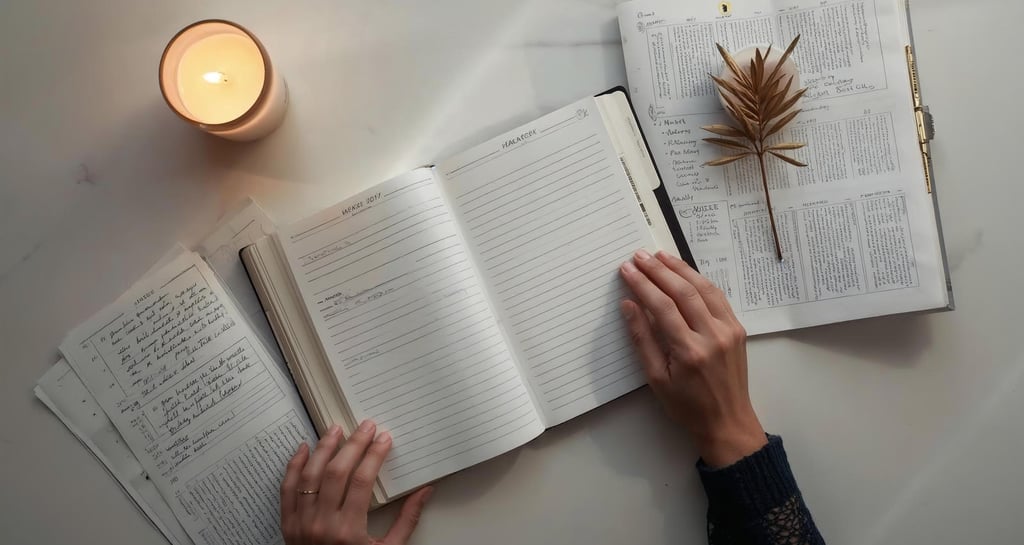
Imagine starting your day already feeling okay. Not because everything is perfect. Not because your schedule is clear or your relationships are easy or your to-do list is short. But because there is something inside you — a quiet, steady kind of okayness — that doesn't depend on any of those things.
That is what emotional safety feels like. And the beautiful thing is: it is something you can build. Deliberately, gently, at your own pace. This is a guide for doing exactly that.
What Emotional Safety Really Means
Emotional safety is a felt sense — a soft but real knowing that you are allowed to exist as you are. That your feelings have a place. That you don't need to be smaller, quieter, or more convenient in order to belong — starting with belonging to yourself. It is the ground beneath everything else.
When you have it, you move through your days differently. You make decisions from a clearer place. You rest more fully. You connect more genuinely — with others, and with your own inner world. Things that used to knock you sideways start to feel more navigable. Not because life becomes easier, but because you become steadier.
Here's the most important thing to understand: emotional safety is built from the inside.
The outside world can support it — honest relationships, moments of quiet, beautiful spaces. But it cannot be the source of it. That role belongs entirely to you. Which is, when you think about it, genuinely good news. Because it means no one can take it away.
The 7 Practices That Build It
These practices are real and concrete. You don't need to start all of them at once. Pick the one that calls to you first and let it settle before you add another. This is not a checklist to complete. It's a collection of invitations.
1. Start Learning Your Own Nervous System
Your nervous system is one of the most intelligent systems you have. It is not your enemy. It is not dramatic. It is simply doing what it was designed to do — read your environment and respond accordingly. When you understand how it works, you stop fighting it and start working with it. That shift alone can change everything.
There are essentially two activated states to get familiar with:
High activation — this feels like urgency, a racing mind, tension in the body, difficulty slowing down. Thoughts move fast. You might feel irritable, anxious, or like you need to do something immediately.
Low activation — this feels like flatness, heaviness, going through the motions. Energy is low. Motivation is quiet. Things that usually matter feel a little distant.
Both of these are normal nervous system responses. Neither of them means something is wrong with you. What builds emotional safety is learning to recognize which state you're in — and having a few gentle ways to come back to center.
A practice called orienting is one of the simplest and most effective. When you feel your system activated, pause. Slowly let your gaze move around the space you're in. Let your eyes actually land on things — the light coming through a window, a plant, the texture of a surface nearby. Let your body take in: I am here. Right now. This is safe.
It works because it brings the nervous system into the present moment, where it can actually assess what's happening — rather than responding to patterns from the past.
Try it today. Just once. Notice what happens.
2. Practice Staying With Yourself in Small Moments
Emotional safety is not built in grand gestures. It is built in small ones — in the thousand tiny moments throughout a day where you either stay with yourself or quietly abandon yourself.
Self-abandonment sounds serious, but it often looks like very ordinary things:
Dismissing what you feel before you've even let yourself feel it. Saying "it's fine" when it isn't. Overriding a quiet "no" in your body because someone else seems to need a "yes." Explaining yourself before anyone has asked for an explanation.
These small moments add up. Over time, they teach some part of you that your experience isn't quite trustworthy — or at least, not worth staying with. The practice is the opposite. It's learning to stay.
What this looks like in real life:
When you notice a feeling arising — even a small or inconvenient one — try this: place one hand on your chest and say internally, I notice that. I'm here. You're not analyzing it. You're not fixing it. You're simply acknowledging that it's there, and that you're not going anywhere.
When you're asked to do something and you're not sure how you feel about it, try giving yourself a beat before you respond. Even a breath. Let your actual answer have a moment to surface before your people-pleasing instincts jump in.
When your inner voice starts criticizing you, notice it without agreeing. That's an old pattern speaking. It's not the whole truth.
These moments accumulate into something remarkable: a felt sense that you can be trusted — by yourself. That you will not leave yourself behind. That is the heart of emotional safety, and it is built one small moment at a time.
3. Create Rituals That Belong Only to You
There is something quietly powerful about having practices in your life that exist purely for you. Not to be productive. Not to show up better for others. Not to optimize anything. Just — for you.
Ritual is one of the most underrated tools for building emotional safety, and here is why: it teaches your body, in a language it understands, that you are worth attending to. That your experience matters enough to mark with intention. It doesn't need to be elaborate. It needs to be consistent and it needs to be yours.
Some rituals worth exploring:
A morning check-in before the day asks anything of you. Even two minutes. Sit with yourself before you reach for your phone. One hand on your heart. Ask: How am I actually feeling right now? Not how you should feel. Not how you want to feel. Just what's actually there. Then let the day begin.
An evening closing ritual. At the end of the day, before sleep — take a moment to gently close what happened. A few slow breaths. A simple acknowledgment: Today was like this. I showed up with what I had. The nervous system genuinely benefits from completion. Without it, the day just bleeds into the next.
Movement as listening. A slow walk with no headphones, no podcast — just you and the movement. A few minutes of stretching where you follow what your body wants, rather than following a routine. This is your body being allowed to speak — and you being someone who listens.
A slow beauty or body ritual. A skincare routine done with full attention. A bath with a candle and no agenda. Slowly rubbing oil into your hands like they're worth the time — because they are. These practices are not indulgent. They are a way of inhabiting your own body with care, which is one of the most grounding things you can do.
When you build rituals like these, you are not just creating pleasant moments. You are laying down evidence, again and again, that you are someone who shows up for herself.
4. Let Your Space Support You
Your environment affects your nervous system more than you probably realize — quietly, continuously, in the background of everything you do. A space that feels calm genuinely supports emotional regulation. Not because aesthetics are spiritual, but because your body is constantly reading its environment and adjusting accordingly. Visual chaos signals stimulation. Clutter creates low-grade cognitive load. Softness and order — even subtle amounts of it — communicate something different to your nervous system: you can rest here.
This is why creating a home environment that feels like a sanctuary is not a lifestyle choice. It is an emotional practice. And it doesn't require a perfectly styled home. It requires intentionality about a few things:
One corner that is fully calm. Even in a small space, there is usually somewhere you can create a small refuge — a chair with good light, a surface that stays clear, a window you love. Let that be a place you actually return to.
Softening what enters your senses. Lighting matters. Sound matters. What you see when you first walk into a room matters. These are adjustable, and adjusting them is worth the small effort.
Bringing nature in. A plant. Seasonal flowers. A stone from somewhere meaningful. Nature has a measurable calming effect on the nervous system — and having even small elements of it in your space works. Think of your home not as a backdrop to your life, but as something that actively holds you. When it does that well, you feel it. You walk in and something in you softens.
That is the goal.
5. Learn to Receive
This is one of the quieter practices — and often one of the most transformative. Many women are extraordinarily good at giving. At showing up, supporting, offering, anticipating needs. And far less practiced at the other direction: allowing themselves to receive.
To receive a compliment without immediately deflecting. To accept help without immediately planning how to repay it. To sit in a moment of care without feeling like you need to earn it. To let something good simply land — without shrinking it, explaining it away, or rushing past it.
Receiving is actually a skill. It requires presence. It requires a belief, somewhere deep down, that you are worth receiving — that good things coming toward you are welcome and appropriate, not suspicious or accidental.
A simple practice: This week, when someone offers you something kind — a warm word, a hand with something, a moment of genuine care — resist the reflex to immediately redirect it or minimize it. Take a breath. Say thank you and actually mean it. Let a beat of quiet be there. Let it land.
Notice what happens in your body. For many women, this feels slightly uncomfortable at first — which is information. It means there is room for your capacity to receive to grow. And as it does, something shifts. The relationship between you and life starts to feel less like a one-way channel of output — and more like a conversation. A flow. Something that nourishes you too.
6. Choose Honesty in at Least One Relationship
We co-regulate. It is one of the most beautiful and underappreciated aspects of being human — our nervous systems genuinely influence each other. The presence of a calm, trustworthy person calms us down at a physiological level. Connection itself is regulating. This means that having even one relationship where you feel genuinely safe — where you don't have to perform, manage yourself, or carefully curate what you share — is a real and significant contribution to your emotional foundation.
You don't need many. You need honest ones.
An emotionally safe relationship isn't one where everything is easy or conflict-free. It's one where you can be known — where showing up as you actually are doesn't feel dangerous. Where you can say I'm struggling or I'm uncertain or I changed my mind without bracing for the response.
If you don't fully have that right now, start here: practice being slightly more honest in one conversation this week. Not all the way open — just a little more there. Say the thing that's actually true instead of the thing that's easier. Notice how it lands.
Emotional safety in relationship is built gradually, through small acts of choosing honesty over management. Each one is a tiny expansion of what you allow yourself to be.




7. Make Friends With Your Emotions
This might be the most foundational shift of all. Emotional safety, at its deepest level, means feeling safe with your own emotional experience. Not needing your feelings to be different, quieter, or more convenient. Not rushing through them. Not treating them as disruptions to manage — but as information to listen to.
Your emotions are extraordinarily intelligent.
Anger is often the emotion that says: something here isn't right. A boundary has been crossed. Pay attention.
Sadness says: this mattered. You cared about this. Let yourself know that.
Fear says: something feels uncertain. Let's slow down and look at this carefully.
Joy says: this is aligned. This feels true. More of this.
Longing says: there is something you want. It is allowed to exist.
When you learn to turn toward your emotions with curiosity — asking what are you trying to tell me? instead of how do I make you stop? — your inner world becomes less threatening and more interesting. It becomes a place you can actually live in.
A practice: Next time you notice a difficult emotion arising, try naming it — out loud or in writing. I feel anxious. I feel sad. I feel disappointed. Research consistently shows that naming an emotion reduces its intensity and brings the thinking brain back online. It is one of the simplest emotional regulation tools available, and it works every time.
Then, if you can, get curious. What is this emotion pointing to? What does it need — even just to be witnessed for a moment?
You are not at the mercy of your emotions. You are in relationship with them. And like any relationship, the quality of it improves enormously when you actually show up.
How These Practices Work Together
You might have noticed that none of these practices are about achieving a permanent state. They are about building a relationship — with your nervous system, your body, your feelings, your space, your truest self. That relationship grows the same way all real relationships do: through consistency, through showing up even in small ways, through choosing it again and again even when it's not dramatic or immediately rewarding.
The woman who has emotional safety doesn't have a perfect life. She has a practiced way of returning to herself. Of knowing that whatever comes, she has enough steadiness inside to meet it — and the gentleness to let herself be human in the process.
That is available to you. Not as a distant aspiration, but as something you can begin building today, with whatever small step feels right.
Start there. And notice what happens next.
Where to Begin — If You Want One Starting Point
If you're not sure where to start, try this:
Today, choose one moment where you stay with yourself instead of rushing past yourself.
It might look like: sitting with a cup of tea without reaching for your phone. Noticing how you actually feel before you tell someone you're fine. Taking one slow breath before you respond to something that activated you.
One moment. That's the entry point.
The practices in this article will be here when you're ready to go deeper. But the foundation is always the same — a single, small, genuine act of staying with yourself.
And it turns out, that is enough to begin.
You may feel drawn to these gentle reflections as well.
Contact
© 2026 All rights reserved.
Email: