Living deliberately with calm, depth, and intention in a fast world.

Tarot for Beginners: A Slow, Intuitive Introduction to Reading Cards
Tarot for beginners doesn't have to feel overwhelming. This is a slow, intuitive introduction to reading tarot cards as a tool for self-reflection, feminine intuition, and intentional living — not fortune-telling.
Written by Eszter
5/26/202612 min read
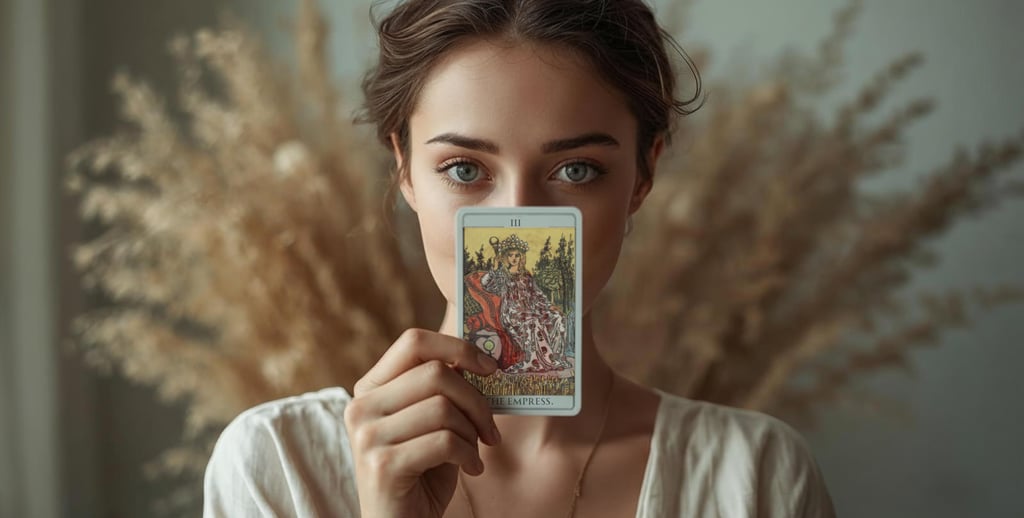
There is something about symbols. Not what they mean in a dictionary sense — not the tidy, catalogued definition. But what they do when you sit with them long enough. How they move something in you that didn't have words before.
That is what drew me to tarot. Not the mysticism, not the fortune-telling, not the idea that a card could tell me what was coming. The symbols. The way a single image — a woman pouring water between two vessels, a tower struck by lightning, a fool stepping off a cliff with a flower in his hand — can land somewhere in you that logic doesn't quite reach. I started exploring tarot on my own. Quietly, out of curiosity. And what I found was something I hadn't expected: the cards don't give you answers. They give you a language for what is already moving underneath.
I've pulled cards with others too, and there have been moments — genuinely surprising ones — where something in the spread was so precise it stopped the conversation. Not because the card predicted anything. But because it named something that had been there, unspoken, waiting.
What I've learned is that you can't force this. You have to tune in. And the deeper you go — the more time you spend with the images, the more pulls you make — the more the cards reveal. Not just their meanings, but new ones. A detail in the illustration you hadn't noticed before. An interpretation that only makes sense in this moment, this situation, this question you brought to the table today.
That is what makes tarot a living practice rather than a fixed system.
And that, I think, is worth exploring slowly.
What the Cards Are Not — And What They Are
Let's start here, because I think a lot of the resistance around tarot comes from what people assume it is. Tarot is a deck of 78 cards, divided into two sections: the Major Arcana and the Minor Arcana. Each card carries an image, a symbol, an energy. The Fool stepping off a cliff with a flower in his hand. The High Priestess sitting between two pillars, knowing something she will not yet say. The Tower cracking open in a flash of lightning, because some things have to fall before they can be rebuilt.
These images are not random. They are a symbolic map of human experience — the full arc of it, from naïve beginning to hard-won wisdom and everything chaotic, tender, and transformative in between.
When you draw a card, you are not receiving a prophecy. You are receiving a mirror.
The card shows you something. It might be a fear you have been quietly carrying. A pattern you have been repeating. An invitation you haven't accepted yet. What you do with that reflection is entirely yours to decide.
This is why tarot is, at its core, a self-reflection practice — not a fortune-telling tool. The difference matters. One puts the future in someone else's hands. The other puts the present back in yours.
A Brief History — Because Context Changes Everything
Tarot cards originated in 15th century northern Italy, where they were used as playing cards for a game called tarocchi. There was nothing mystical about them yet. They were entertainment, strategy, social ritual. It wasn't until the 18th century that occultists began to see the cards as something more — as a system of esoteric knowledge connected to astrology, numerology, and the Kabbalah. The Rider-Waite-Smith deck, published in 1909, became the foundational visual language of modern tarot. Its creator, Arthur Edward Waite, worked with artist Pamela Colman Smith — a woman whose contribution was largely uncredited for decades, though her images shaped everything that came after.
I find something worth sitting with in that history. A woman drew the cards. Another woman's hands shuffle them now. There is a quiet lineage here.
The Structure of a Tarot Deck
Understanding the deck is less complicated than it sounds. Think of it as two distinct conversations happening at once.
The Major Arcana: The Big Themes
Twenty-two cards. These are the archetypal forces, the soul-level experiences, the moments that mark us.
The Major Arcana begins with The Fool — numbered 0 — and ends with The World — numbered 21. Between them: The High Priestess, The Empress, The Tower, The Star, The Moon. These are not just cards. They are chapters in a story every human being lives through.
When a Major Arcana card appears in a reading, it tends to carry more weight. It points to something bigger than the day's logistics — a theme, a transition, a deeper invitation.
The Minor Arcana: The Everyday
Fifty-six cards, divided into four suits: Wands, Cups, Swords, and Pentacles. Each suit corresponds to a different area of life.
Wands speak of passion, creativity, drive, the fire that moves you.
Cups speak of emotion, relationship, intuition, the feeling life.
Swords speak of thought, conflict, clarity, the things that cut.
Pentacles speak of the physical — the body, the home, the material, the practical.
Within each suit, there are numbered cards (Ace through Ten) and Court Cards (Page, Knight, Queen, King). The Court Cards often represent either an aspect of yourself or a person in your life. The Queen of Cups, for example — intuitive, emotionally available, deeply perceptive — might be who you are in this season, or who you are learning to become.
Why Women Are Drawn to Tarot
I have thought about this. I don't think it is a coincidence. We live in a world that was not built for the way many women process experience. The pace is wrong. The language is often wrong. The dominant culture rewards speed, certainty, performance — and dismisses slowness, ambiguity, intuition, cyclical thinking.
Tarot offers something different. It asks you to slow down. To sit with an image rather than immediately analyze it. To trust that what arises in you when you look at a card — the tightening in your chest, the unexpected tears, the flash of recognition — is information.
Tarot honors the kind of knowing that is non-linear. The feminine way of knowing, you might call it. Not "what is the logical conclusion?" but "what does this feel like in my body? What is this card showing me that I already knew but hadn't named yet?"
For women who are in the process of reconnecting with their intuition — particularly after years of overriding it, of shrinking it to fit into rooms that didn't welcome it — tarot can be a profound practice of coming home to yourself.
How to Begin: A Slow Approach for Beginners
I want to say something before the practical part, because I think it matters more than any of the steps below. My own relationship with tarot has always been spontaneous. These days I pull when the impulse comes — not on a schedule, not as a ritual I have to maintain. There have been periods when I drew one card every morning, and that daily rhythm taught me something different than the occasional pull does. Both are valid. Both reveal things.
The point is not to find the right way to use tarot. The point is to find your way — and to let that change as you change.
1. Choose a deck you are visually drawn to.
Don't start with a deck because it is "the best for beginners" or because someone famous uses it. Start with a deck whose images speak to something in you before you understand why. The Rider-Waite-Smith is the most widely referenced, which makes learning easier — nearly every guidebook uses its imagery. But if another deck calls to you, trust that call.
The visual language matters. You will spend a lot of time looking at these images. They should feel alive to you.
2. Before you memorize, feel.
Hold the card. Look at the image. Notice what happens in your body before you reach for the guidebook. Where does your eye go first? What is the mood of the card? Does it feel expansive or contracted? Light or heavy? Familiar or foreign?
This is not a lesser form of reading. This is reading.
3. Start with one card a day.
The single card draw is one of the most underestimated practices in tarot. Each morning — or at the start of a quiet moment — pull one card. Ask a simple question: What do I need to be aware of today? What energy am I moving through?
Don't ask the card to predict. Ask it to illuminate. Then sit with it. Write a sentence or two in your journal. Return to it at the end of the day. See what showed up.
Over time, this practice does something subtle and significant. It trains you to notice — to be in conversation with your own inner life, using the cards as a structure that makes the conversation easier to begin.
4. Learn the meanings gradually, not all at once.
There are 78 cards. You do not need to know all of them before you begin. In fact, trying to memorize them all at once will likely make you feel overwhelmed and disconnected from the practice.
A gentler approach: when a card comes up, look it up. Read two or three interpretations. Notice which one resonates. Write your own interpretation down. Slowly, organically, the meanings will settle into you rather than sitting on top of you.
5. Trust your friction.
Some cards will unsettle you. The Tower. The Three of Swords. Death. (Yes, Death is a card — and it means transformation, endings, the shedding of what has run its course.) When a card makes you uncomfortable, that discomfort is worth being curious about. Not afraid of. Curious.
Ask: Why does this land heavily? What in my life does this image touch? The cards that unsettle us are often the ones carrying the most valuable information.
What the Major Arcana Wants You to Know
Let me walk you through a few of the most significant Major Arcana cards — not their complete meanings, but their essential invitation. These are the ones I find women return to again and again.
The High Priestess She sits between two pillars — one black, one white. She holds a scroll she does not offer you. She knows things she will not yet say.
She is the card of intuition, of the deep inner knowing that predates logic. When she appears, she is asking: what do you already know, underneath the noise? What are you dismissing because it came too quietly?
The Empress Abundant. Earthen. Soft and powerful in the same breath. She is creative energy in form — the feminine principle as generative, embodied, receiving.
She asks: where are you withholding your own abundance? Where are you refusing to receive? Where have you forgotten that your body is not the enemy of your soul — it is the vessel?
The Moon Uncertainty. The liminal space. The feeling of not knowing which path is real and which is illusion. Anxiety, but also depth. The invitation to trust the process even when you cannot see clearly.
She asks: can you be in the not-knowing without forcing a resolution? Can you walk through the fog without pretending you can see?
The Star After The Tower tears something down, The Star arrives. A woman kneeling by water, pouring back into the earth and into the pool at once. Renewal. Hope that is not naïve but earned.
She asks: what is being restored in you right now? What do you allow yourself to hope for, quietly, in the dark?
I want to stay here for a moment — with The High Priestess and The Moon specifically.
These are the two cards I find most quietly instructive. Not because they bring clarity. Because they bring the opposite.
When either of them appears in a pull, I've learned to recognize a particular feeling: something is working in me at a deeper level. A process that hasn't surfaced yet. Not a problem to solve — more like a slow tide moving underneath, doing what it needs to do without my interference.
I've come to receive that feeling with something close to relief. It means I don't have to force an answer right now. The card is simply naming what is already happening.
That, to me, is one of the most valuable things tarot can do. Not illuminate the future — but confirm the depth of the present.
Common Beginner Questions — Answered Simply
Do I need a special ritual to use tarot?
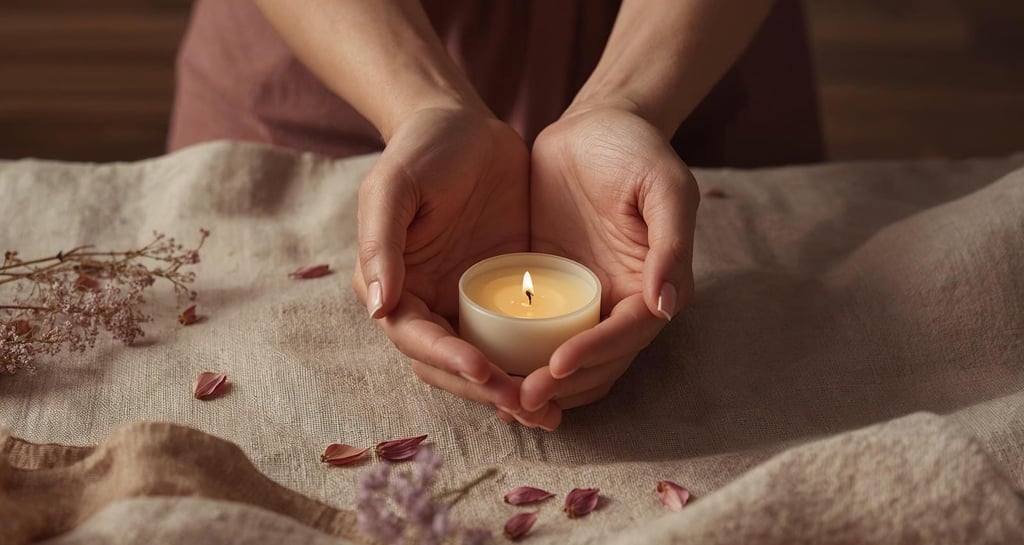
No. Some people like to light a candle, set an intention, create a quiet space. That ceremony can be beautiful — it marks the moment as different from the ordinary pace of the day. But it is not required. The cards work whether or not you have incense.
What matters is that you actually pause, actually ask, actually listen.
Can I read for myself?
Yes. This is, honestly, where I find tarot most valuable — in the private conversation between me and a card, without anyone else's interpretation in the room. Some traditional readers suggest you can't be objective enough to read for yourself, and there is a truth in that. Your own blind spots are real. But self-reading is a practice of building the muscle of self-honesty, and that is worth more than objectivity.
What if I draw a "scary" card?
Breathe. Then get curious rather than afraid.
Every card — even the ones that feel dark — carries information rather than verdict. The Ten of Swords, which shows a figure lying face-down with swords in their back, is not a good morning card by most accounts. But what it often means is simply: this chapter is done. Something is over. Stop fighting the ending.
That is not a curse. Sometimes that is exactly the news you needed.
Do I need to believe in anything to use tarot?
No. You can approach tarot as purely a psychological tool — a deck of archetypal images that help you access different parts of your own experience. You do not need to believe the cards are magic. You need only believe that you have an inner life worth listening to.
Tarot as a Feminine Intuition Practice
There is a version of tarot that is about control — about knowing the future, about certainty, about finding an external source to tell you what to do. That version will disappoint you. It will also keep you dependent on something outside yourself.
The tarot practice I am describing — and the one I return to, especially in seasons when I feel disconnected from my own knowing — is about the opposite. It is about bringing yourself into contact with your own interior. About asking questions that matter. About building a relationship with your own intuition in the same way you would build a relationship with a friend: slowly, with curiosity, with a willingness to be surprised.
Feminine intuition is not magic, though it can feel like it when you've been ignoring it for long enough and it suddenly speaks clearly. It is pattern recognition that travels through the body rather than through logic. It is the quiet signal beneath the noise that says yes, this or no, not yet or there is something here you haven't looked at.
Tarot gives that signal a language. And in a world that rarely asks women to slow down and listen to themselves, that is not nothing.
That is, in fact, everything.
A Simple Practice to Begin Today
If you want to begin before you have a deck, you can. Take a moment of stillness — morning, evening, the middle of the afternoon when the light shifts.
Ask yourself a question you have been afraid to look at directly. Write it down.
Now, without a card, write the first image that comes. An animal. A landscape. A color. A weather pattern. Don't analyze it. Let it be whatever it is.
Then ask: What is this image showing me?
This is the gesture of tarot. This is the practice before the practice.
When you are ready to hold the cards — when the deck arrives and you unwrap it and feel the weight of 78 images in your hands — you will already know how to begin.
The Real Invitation
Tarot, at its core, is a practice of self-knowledge. And self-knowledge is never a straight line — it is a path that curves back on itself, shows you the same thing from a different angle, surprises you with a detail you missed the first time.
That is what I find endlessly interesting about the cards. You don't arrive at their meaning. You keep discovering it. A symbol you've seen a hundred times suddenly reveals a new layer — because you are in a different place now, asking a different question, carrying a different weight.
There is something quietly magical about that. Not magic in the dramatic sense — not prophecy, not fate. But the magic of a system that meets you exactly where you are, every single time, if you are willing to look.
If you are just beginning: you don't need to understand everything. You don't need the right deck, the right ritual, the right question. You need only a genuine willingness to look — at the image, and then, gently, at yourself.
The symbols will do the rest.
If this resonated, you might find it worth exploring grounding practices that create the conditions for this kind of inner listening — because tarot works best when you are genuinely present, not rushing through. And if shadow work calls to you, the cards can be a profound companion for meeting the parts of yourself you haven't fully seen yet.
You may feel drawn to these gentle reflections as well.
Contact
© 2026 All rights reserved.
Email: