Living deliberately with calm, depth, and intention in a fast world.

Feminine Energy and Stoicism: A Quiet Power Beyond Control
An essay on feminine energy and Stoicism, where emotional depth meets inner steadiness, and softness is held by quiet strength, presence, and embodied wisdom.
Written by Eszter
1/10/20265 min read


At first glance, feminine energy and Stoicism seem to belong to entirely different worlds. Feminine energy is often described through softness, intuition, emotional depth, and receptivity. Stoicism, by contrast, is usually framed as disciplined, rational, and emotionally restrained. One is fluid and cyclical, the other steady and contained. And yet, beneath these surface impressions, they meet in a much quieter place.
Both are concerned with the same essential question: how to remain inwardly stable, dignified, and self-possessed in a world that constantly pulls us outward.
Stoicism is frequently misunderstood as emotional suppression. Feminine energy is often mistaken for emotional reactivity. In reality, neither is true. Both traditions, when understood deeply, are not about denial or excess, but about inner containment.
The foundational Stoic thinkers, such as Marcus Aurelius, Epictetus, and Seneca, were men writing in patriarchal societies. Women’s inner lives were rarely centered in their work. Still, the philosophy they articulated was never inherently masculine. Stoicism was always a human philosophy, concerned not with dominance or control over others, but with inner freedom, dignity, and clarity.
Seen this way, Stoicism does not oppose feminine energy. It offers it a structure.
Feminine Energy as Emotional Depth
Feminine energy is often misunderstood as being driven by emotion, yet in its mature form it is something far more grounded. It is a way of relating to feeling that is spacious rather than overwhelming, intuitive rather than impulsive, and receptive without losing discernment.
Mature feminine energy is deeply felt and gently contained. It allows emotion to move through the body without taking over the inner landscape.
True feminine energy supports emotional depth with inner steadiness, sensitivity with self-respect, and openness with clear boundaries. This quality of self-holding is not forceful, yet it is quietly regulating.
This is where Stoic philosophy becomes unexpectedly supportive, offering structure without rigidity and steadiness without emotional denial.
The Quiet Power of Knowing What Is—and Isn’t—Yours
At the heart of Stoicism lies a simple distinction: there are things within our control, and there are things outside of it.
For women, this distinction can be quietly transformative.
We do not control how others behave, how quickly they choose or commit, or how we are perceived or interpreted. What we do control is far subtler, and far more important: our inner dialogue, our emotional pacing, and our boundaries and self-respect.
When this boundary is unclear, sensitivity turns into vigilance. Emotional attunement becomes self-monitoring. Feminine energy collapses inward, constantly scanning for outcomes instead of inhabiting the present.
Stoicism gently interrupts this pattern. It does not ask women to harden themselves against feeling. It asks them to stop outsourcing their inner stability.
Feeling Without Being Ruled
Contrary to popular belief, Stoicism was never about denying emotion. The Stoics understood emotions as natural responses. What they cautioned against was allowing those responses to dictate identity, behavior, or self-worth.
Emotional regulation, in the Stoic sense, is not suppression. It is choice.
This aligns naturally with mature feminine energy. A woman grounded in her feminine does not deny her emotions, nor does she dramatize them into identity. She feels. She listens. And then she chooses.
She does not rush to explain herself. She does not demand clarity before it has arrived. She allows space.
Stoicism supports this pause. It creates distance between sensation and reaction, allowing softness to remain intact without slipping into self-abandonment.
Dignity as a Feminine Virtue
At the meeting point of Stoicism and feminine energy lies dignity. Not stiffness. Not emotional distance. But quiet self-possession.
Dignity does not chase reassurance. It does not over-explain boundaries. It does not collapse in the absence of validation.
Stoic philosophy teaches that worth is not negotiated through outcomes. Feminine energy, when anchored in this understanding, becomes calm rather than anxious, receptive rather than reactive.
In a culture that often rewards over-giving, emotional labor, and constant availability, this combination is quietly radical.
Stoicism allows women to disengage without guilt, rest without justification, and choose peace over performance. This is not withdrawal from life. It is selective engagement.
Calm as a Form of Magnetism
There is a subtle magnetism that emerges at the intersection of Stoic stillness and feminine presence. Calm is inherently attractive, not because it performs, but because it signals inner safety.
Stoic steadiness gives feminine energy a grounded center. Feminine warmth softens Stoic restraint. Together, they create a presence that does not rush, does not chase clarity prematurely, and does not collapse under uncertainty.
This is not strategy. It is embodiment.
Sensitivity, Without Self-Sacrifice
For sensitive women, this integration can be especially healing. Sensitivity does not require self-sacrifice. One can care deeply without over-attaching, feel intensely without losing containment, and remain compassionate without dissolving boundaries.
This is not emotional shutdown. It is emotional maturity.
At its core, Stoicism returns again and again to the idea of inner authority. No external event, no other person, and no uncertain outcome has the power to destabilize the inner world unless it is given permission.
For women reclaiming feminine energy, this is not about control or dominance. It is about self-trust.

The Soft Stoic Woman
Perhaps it is time to release the image of Stoicism as rigid and masculine, just as it is time to release the idea of feminine energy as fragile or ungrounded.
A new archetype quietly emerges where they meet. She is soft, but grounded. Open, but discerning. Emotional, but self-contained.
She does not suppress her heart. She protects it with wisdom.
Here, philosophy becomes embodied rather than abstract. Stoicism becomes less about discipline and more about devotion to inner peace. Feminine energy becomes less performative and more rooted.
This is not contradiction.
It is balance.
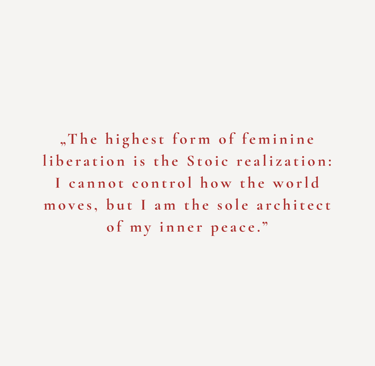
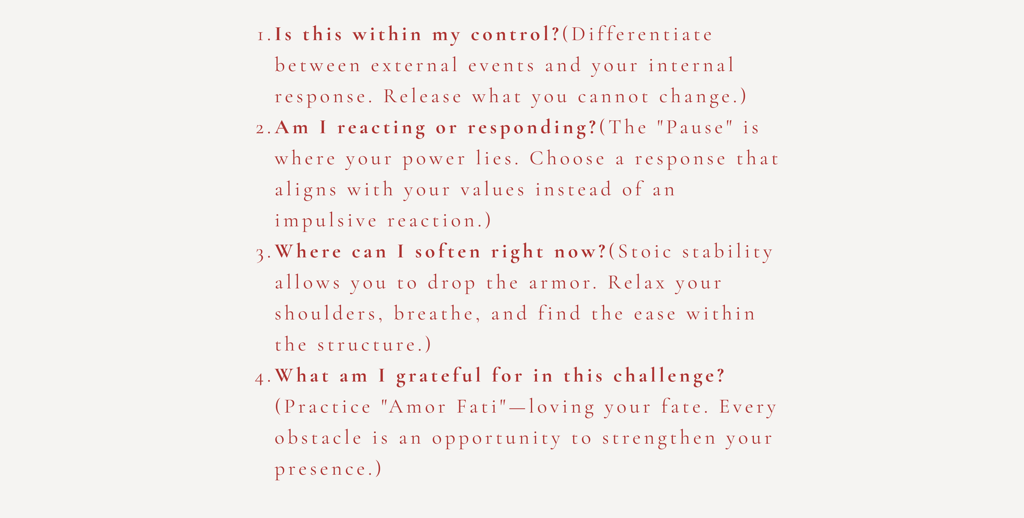
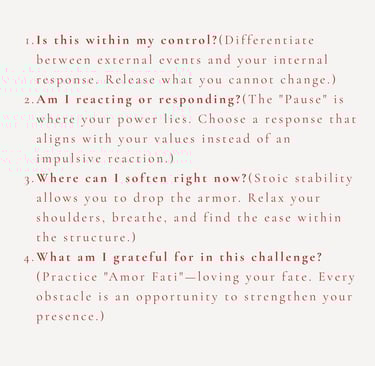
Quick Stoic Check-in for Daily Balance
Use these four questions whenever you feel overwhelmed, to quickly return to your feminine center:
You may feel drawn to these gentle reflections as well.
Contact
© 2026 All rights reserved.
Email: