Living deliberately with calm, depth, and intention in a fast world.

Stoic Journaling Before It Had a Name — Ancient Reflection for Modern Women
An exploration of Stoic journaling, feminine self-love, and daily reflection—where ancient philosophy supports inner steadiness and calm presence.
Written by Eszter
1/24/20265 min read


Quiet Daily Practices, Ancient Wisdom, and Feminine Self-Respect
Journaling has become a modern ritual.
We use it to process emotions, clarify goals, regulate the nervous system, and make sense of our inner lives. For many women, it is one of the few quiet spaces left where we can hear ourselves think.
Yet long before journaling was framed as self-care or personal development, it existed as something simpler — and perhaps deeper. For the Stoic philosophers, reflection was not a productivity tool or a creative outlet. It was a daily practice of remembering who they were, returning to inner steadiness, and realigning with what truly mattered.
Not motivation. Not manifestation. But inner order.
And in that sense, the Stoics may have been the earliest practitioners of what we now call journaling — though they would never have used that word.
Philosophy as a Daily Practice, Not an Abstract Idea
Stoicism is often misunderstood as emotional suppression or rigid self-control. In reality, it was a philosophy designed to be lived every single day. The Stoics were not interested in lofty ideals that remained on paper. They believed philosophy should shape how you woke up in the morning, how you spoke to others, how you responded to difficulty, and how you returned to yourself at night.
This is why daily reflection mattered so deeply to them.
Epictetus encouraged regular self-examination to notice where one had lost inner composure.
Seneca wrote about reviewing the day each evening, not to judge himself harshly, but to cultivate clarity and ethical alignment.
Marcus Aurelius’ Meditations were never intended for publication at all — they were private notes, reminders written to himself, by himself, for himself.
In other words, these were not performative texts. They were intimate conversations with the self.
What mattered was not the act of writing, but the ritual of turning inward.
Marcus Aurelius and the Private Act of Remembering
When we read Meditations today, it is easy to forget that we are reading a personal notebook. Marcus Aurelius was the emperor of Rome, burdened with responsibility, conflict, and constant pressure. Yet his writing is not grand or instructional. It is repetitive, humble, and deeply human.
He reminds himself:
not to be carried away by appearances,
not to confuse his role with his essence,
not to surrender his inner calm to external chaos.
Again and again, he returns to the same themes — not because he forgot them intellectually, but because remembering is a daily discipline.
This is a crucial distinction.
Stoic reflection was not about discovering new insights every day. It was about returning to what is already known but easily lost. And this is where the practice begins to feel surprisingly feminine.
Self-Reflection Without Self-Violence
Modern journaling often carries an unspoken pressure:
to optimize,
to heal faster,
to become “better” versions of ourselves.
The Stoic approach was quieter. Their questions were not rooted in self-criticism, but in self-respect.
They asked:
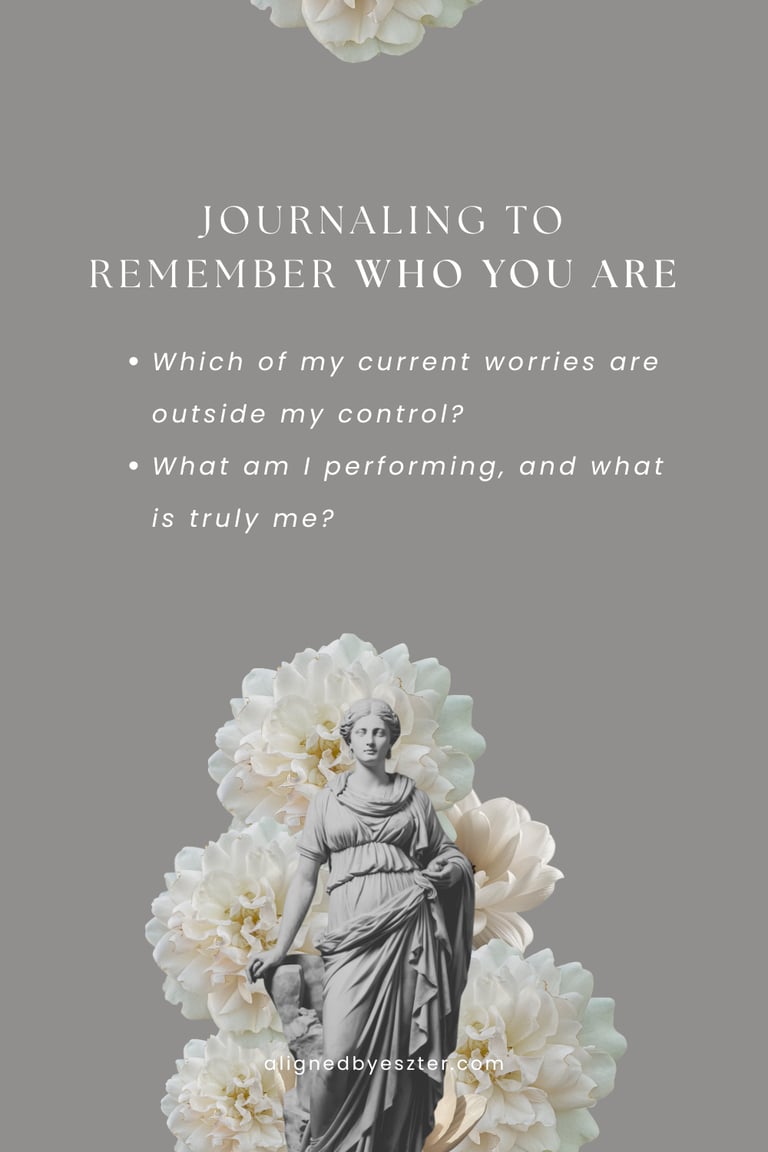
Where did I lose my inner steadiness?
Where did I act out of impulse rather than clarity?
Where did I forget what was within my control?
These were not accusations, they were invitations to realignment. This distinction matters deeply for women. So many women approach self-reflection with an internalized harshness — a sense that we must constantly fix, improve, or justify ourselves. Stoic reflection offers a different tone:
Firm, yes. But calm. Measured. Grounded in dignity rather than shame.
The Feminine Dimension of Stoic Practice
At first glance, Stoicism is often associated with masculine restraint and discipline. But when viewed through a feminine lens, something softer emerges. Stoic self-examination is not linear or aggressive. It is cyclical. It returns again and again to the same inner center.
This mirrors a deeply feminine pattern:
returning rather than conquering,
listening rather than forcing,
stabilizing rather than escalating.
In this sense, Stoic reflection aligns beautifully with feminine self-love — not as indulgence, but as self-respect. Feminine self-love is not about constantly affirming ourselves. It is about taking ourselves seriously enough to stay present.
To notice:
when we abandon ourselves,
when we overextend,
when we surrender our inner authority for approval or comfort.
And then, gently, to come back.
From Stoic Reflection to Modern Journaling
What we now call journaling often overlaps with what the Stoics practiced — but the intention is different.
Modern journaling tends to ask:
How do I feel?
What do I want?
What is holding me back?
Stoic-inspired reflection asks:
Where is my inner ground today?
Where did I act in alignment with my values?
Where did I allow external events to disturb my inner peace?
Neither approach is superior, but when combined, they create something powerful. A journaling practice that is not emotionally overwhelming, yet not emotionally avoidant.
A practice that steadies rather than stimulates.
Gentle Questions Inspired by Stoic Wisdom
Rather than adopting the exact questions of ancient philosophers, we can let their spirit guide us. Here are a few soft, modern reflections inspired by Stoic thought — not as a checklist, but as a quiet invitation:
Where today did I feel most anchored within myself?
When did I sense my inner calm slipping — and what was happening around me?
What quality of character did I embody today, even in a small way?
Where could I respond with a little more clarity tomorrow?
These are not questions that demand answers. They are questions that open space. You do not need to write pages, sometimes a single sentence is enough.
Journaling as Nervous System Regulation
One reason Stoic reflection feels so relevant today is that it naturally supports nervous system regulation. The Stoics understood, intuitively, what we now describe in modern language:
that the mind needs rhythm,
that the nervous system needs predictability,
that inner calm must be practiced, not assumed.
A daily moment of quiet reflection — especially in the morning or evening — signals safety to the system.
It says:
I am here.
I am paying attention.
Nothing needs to be solved right now.
This is not about controlling thoughts, it is about creating internal order.
A Quiet Journaling Practice, Inspired by Stoic Wisdom
You don’t need a long ritual or perfect consistency.
These prompts are not meant to analyze or fix you — only to help you return to inner clarity.
Choose one. Sit with it. Write a few lines, or simply reflect.
Where today did I feel most grounded within myself?
When did I give my energy to something that wasn’t truly mine to carry?
What external event disturbed my inner calm — and what part of it was actually within my control?
Where did I act from quiet self-respect rather than reaction?
What quality of character felt most present in me today?
Where did I rush past myself instead of staying?
What would it look like to meet tomorrow with a little more steadiness?
What does my inner state need right now — not to improve, but to soften?
What can I gently release before the day ends?
You don’t need answers to all of them.
Stoic reflection is not about completion — it is about returning.
Not a Habit to Perfect, but a Space to Return To
Perhaps the most important lesson we can learn from the Stoics is this:
Daily reflection was never meant to be done perfectly.
Marcus Aurelius repeated himself constantly.
Seneca admitted his own failures openly.
Epictetus emphasized practice, not mastery.
The point was not consistency for its own sake, the point was returning.
Returning to:
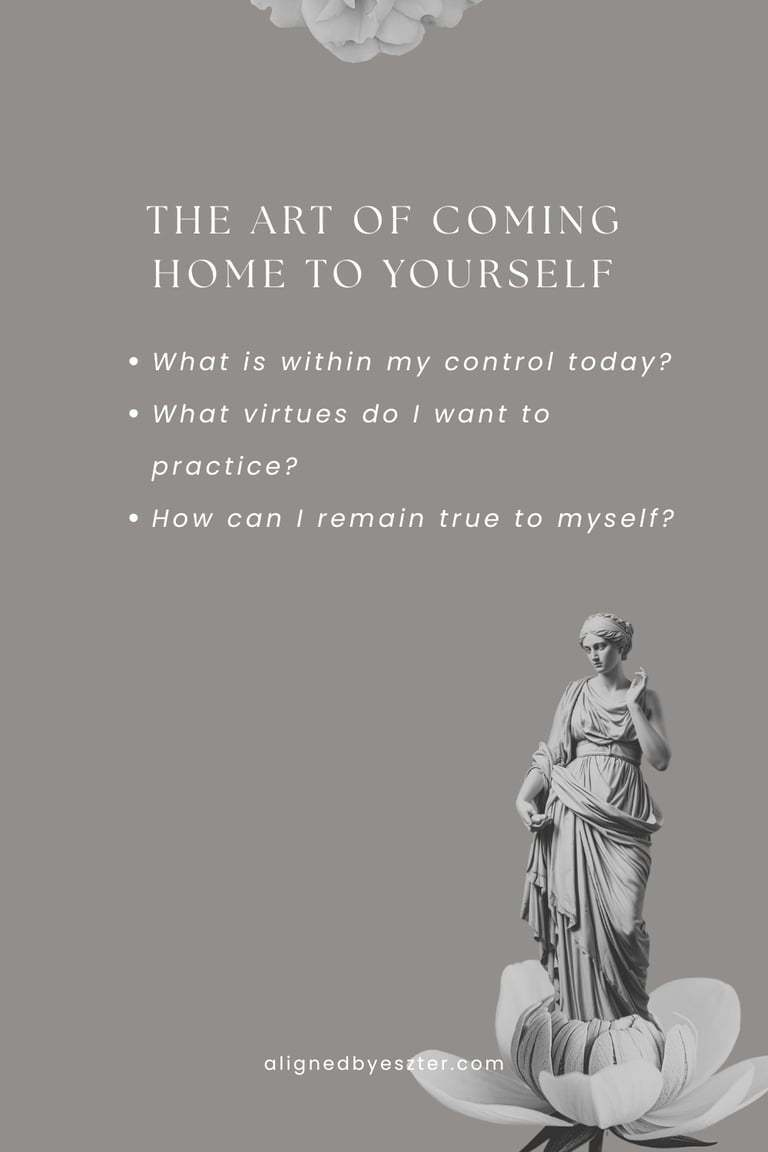
what is within your control,
what kind of person you wish to be,
what inner posture you choose to carry through the world.
This is where journaling stops being a task and becomes a refuge.
Remembering, Not Becoming
We often approach self-work with the belief that we must become something else. Stoic reflection offers a quieter truth: you are not here to become someone new, but to remember who you are beneath distraction, fear, and external noise. In that sense, journaling is not a modern invention. It is an ancient act of remembrance.
A conversation with the self.
A return to inner dignity.
A soft discipline that holds strength without force.
And perhaps that is why, even today, it still feels so deeply necessary.
You may feel drawn to these gentle reflections as well.
Contact
© 2026 All rights reserved.
Email: